


Your monitor checks every morning. Your artery walls need something that works for the 8 hours between every check.
✓ Activates eNOS — the enzyme inside your artery walls that controls sustained blood flow — for 6 to 8 hours per serving. Not the 90-minute spike beet root produces. The wall's own mechanism, sustained.
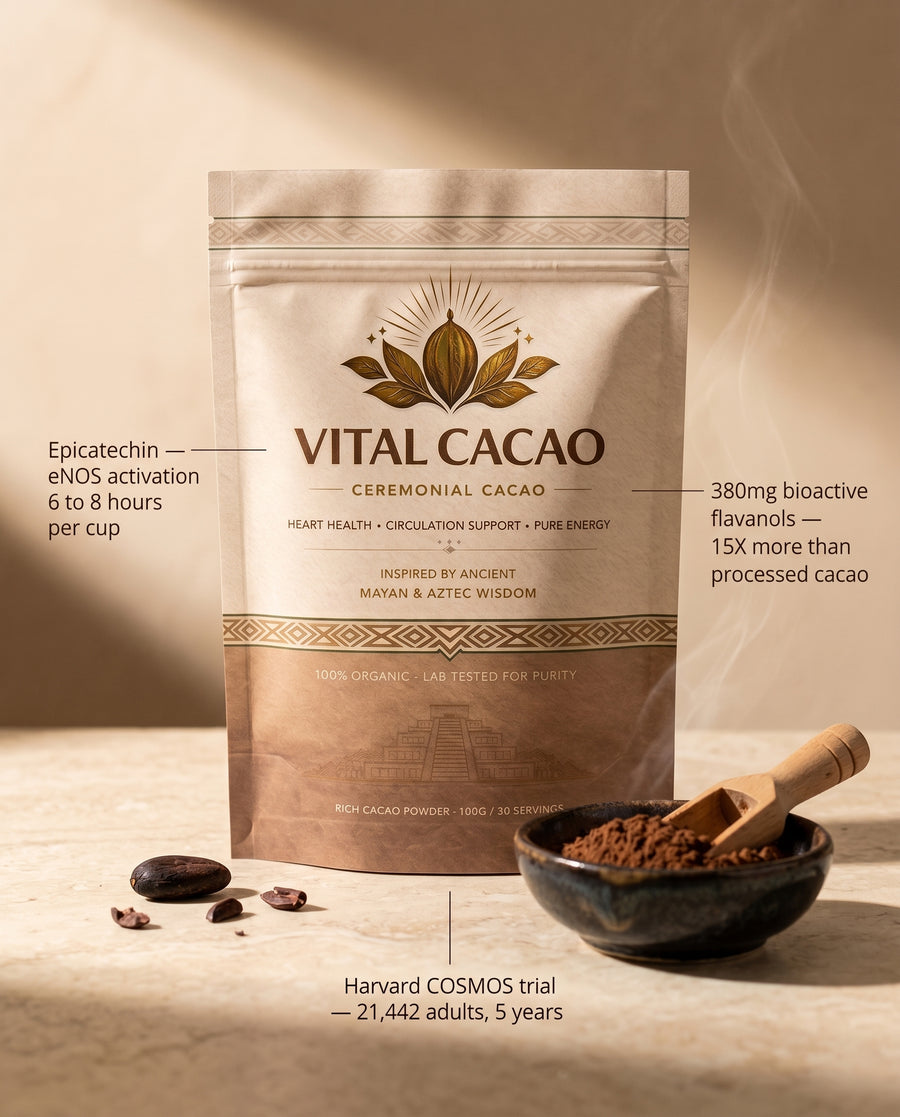
✓ 380mg of bioactive epicatechins per cup — the same profile used in the COSMOS trial that documented a 4.5mmHg systolic reduction across 21,442 Harvard participants. 15X more than processed grocery cacao.
✓ Works through a completely different pathway than your medication. Your prescription manages vasoconstriction chemically. VitalCacao activates the eNOS enzyme naturally. These do not compete — they address different parts of the picture.
✓ A morning ritual that takes 5 minutes and works for the 8 hours your doctor cannot see — so that by week 6 to 8, your next reading tells a different story.

that didn't work.
- FREEBlood Pressure Progress Journal ($19)
- FREEDoctor Conversation Brief ($12)
- FREERitual Recipe Card ($15)
- FREE90-Day Blood Pressure Journey ($19)

that didn't work.
- FREEBlood Pressure Progress Journal ($19)
- FREEDoctor Conversation Brief ($12)
- FREERitual Recipe Card ($15)
- FREE90-Day Blood Pressure Journey ($19)
- FREECeremonial Bamboo Whisk ($15)

that didn't work.
- FREEBlood Pressure Progress Journal ($19)
- FREEDoctor Conversation Brief ($12)
- FREERitual Recipe Card ($15)
- FREE90-Day Blood Pressure Journey ($19)
- FREECeremonial Bamboo Whisk ($15)
What VitalCacao does for your blood pressure
Activates eNOS inside your artery walls. The enzyme that controls how elastic your arteries stay and how well blood flows through them. After 35, eNOS activity quietly declines. VitalCacao reactivates it for 6 to 8 hours per serving — sustained, internally, every morning you drink it. This is the mechanism behind the 4.5mmHg systolic reduction documented in Harvard's COSMOS trial across 21,442 participants over five years.
Works through a completely different pathway than your medication. Your prescription manages vasoconstriction chemically — from outside the arterial wall. VitalCacao activates eNOS from inside it. These are not competing approaches. They address different parts of the same picture. Most customers take both daily.
The side effects your medication creates — this does not. No fatigue from the mechanism. No dry cough. No brain fog. No cold hands and cold feet from restricted peripheral flow. VitalCacao works through a food-based pathway, the same one your body used before decades of cardiovascular load quietly reduced your eNOS activity.
380mg of bioactive epicatechins per cup. The same compound profile used in the COSMOS trial. 15X more than processed grocery cacao. The concentration that activates eNOS at the level the Harvard researchers were actually studying — not the 20 to 40mg that survives Dutch processing and alkalization.
Non-alkalized, cold-processed. Industrial cacao loses up to 90% of its flavanols during standard processing. VitalCacao preserves what the COSMOS researchers were studying, not the processed version on the supermarket shelf.
What's actually inside (and what isn't)
Single-origin Criollo cacao, non-alkalized and cold-processed to preserve full flavanol integrity.
Active compounds per serving:
- Epicatechin & flavanol complex (catechin, procyanidins B1 & B2), activates eNOS for nitric oxide production
- Theobromine (150–200mg), gentle vasodilator, no cortisol spike
- Magnesium (45mg), supports arterial relaxation
- Iron, zinc & manganese, trace minerals, naturally occurring
Nothing added. Nothing removed. Every batch third-party tested for flavanol concentration before it ships.
Nothing that raises cortisol. Nothing that creates rebound vasoconstriction. Nothing that produces the fatigue, brain fog, or nagging cough that comes with the chemical management of blood pressure. What is not in the formula matters as much as what is.
One ingredient. One morning. The reading that moves over time.
The 5-minute morning ritual
Add 5g to your mug, whisk with warm water, drink every morning. By week 6 to 8, the readings on your own monitor begin to shift — the same window the COSMOS research documented for measurable vascular adaptation. This is when the ritual becomes the result. The ritual takes 5 minutes. That is the only barrier between today and the reading your doctor asks about.
Is this third-party lab tested?

Add your text here.


WHEN BEET ROOT, MAGNESIUM, AND CUTTING SALT DIDN'TMOVE YOUR MORNING READING, THE PROBLEM WASN'T YOU. IT'S WHICH MECHANISM THEY WERE TARGETING.
Your artery walls produce their own blood pressure switch. Most things you've tried never activated it.
MORNING READING
The number on your monitor every morning reflects what is happening inside your artery walls, not just the blood volume your medication manages chemically. eNOS is the enzyme your artery walls use to produce nitric oxide and keep blood flowing freely. After 35, it quietly declines. Activating it directly is what moves the reading that beet root and magnesium could not.
MEDICATION SIDE EFFECTS
Fatigue by 2pm. The dry nagging cough. Brain fog that will not lift until noon. Cold hands and cold feet all day. These are the daily cost of chemical vasoconstriction management. VitalCacao works through your artery wall's own enzym, a completely different pathway, which is why customers on Losartan and Lisinopril report these side effects beginning to ease.
THE MECHANISM DIFFERENCE
Beet root raises nitric oxide through dietary nitrate, one external pathway, active for 90 minutes then gone. Epicatechin activates eNOS inside the artery wall itself, sustained for 6 to 8 hours per serving. That is not a minor timing difference. It is the difference between borrowing nitric oxide for 90 minutes and restoring your body's own production capacity for the morning.
YOUR MORNING RITUAL
One scoop. Into whatever you are already drinking. Five minutes. Then the reading you check every morning starts telling a different story, by week 6 to 8 for most customers, which is when their doctor asks what changed. Your monitor is the confirmation. VitalCacao is the mechanism behind it.
Why beet root, magnesium, and cutting salt each address one thing. And why one thing has never been enough to move your morning reading.
Elevated blood pressure isn't one problem. It's three: an artery wall enzyme that quietly stopped working after 35, a nitric oxide effect that spikes and crashes within 90 minutes of a beet root dose, and readings that won't respond because the mechanism your medication targets is chemical, not enzymatic. Most things you've tried addressed one. VitalCacao addresses all three, in sequence, every morning.
ACTIVATE
EPICATECHIN — eNOS ACTIVATIONEpicatechin activates eNOS, the enzyme your endothelial cells use to produce nitric oxide on demand. Nitric oxide signals your artery walls to widen and relax, which is the mechanism behind the systolic reductions documented across 20+ clinical trials on cocoa flavanols and the 4.5mmHg average reduction reported in Harvard's COSMOS trial. It's also why beet root produces a different result: beet root raises nitric oxide through dietary nitrate, one external pathway, active for 90 to 120 minutes, then it drops. eNOS activation is sustained for 6 to 8 hours because it works from inside the artery wall, not around it. That is the difference between borrowing nitric oxide for an hour and restoring your body's own production for the morning.
SUSTAIN
THEOBROMINE + MAGNESIUMTheobromine maintains gentle vasodilation throughout the morning without raising cortisol or heart rate, the rebound effect that makes stimulant-based approaches counterproductive for blood pressure. Magnesium supports arterial smooth muscle relaxation. This is the single pathway magnesium supplements address in isolation, the reason many people find magnesium helps slightly but never moves the morning reading enough. In combination with active eNOS stimulation, it completes the picture magnesium alone can't, sustained through the 6 to 8 hours your medication leaves untouched.
BREAK THROUGH
BYPASSES THE ADMA BLOCKAGEL-arginine was the natural blood pressure supplement that made scientific sense, it converts to nitric oxide through a pathway similar to VitalCacao. The problem is the ADMA enzyme. In adults over 50, ADMA activity rises and blocks the arginine-to-nitric-oxide conversion at exactly the age blood pressure management matters most. This is why L-arginine works in younger adults and stops working when you need it most. Epicatechin bypasses this blockage entirely, it activates eNOS directly inside the artery wall, a pathway the ADMA enzyme does not interrupt. This is why it works where arginine eventually failed, and why the week 6 readings start to move when months of other supplements never did.
What to expect, and when to expect it
Blood pressure adaptation isn't instant. It's cumulative. The biology takes time, and the body shows it in a specific order. Here's what the COSMOS research documented, and what real customers report, at each stage of consistent daily use.
WHEN
One serving every morning, before breakfast or coffee. Same time builds the ritual that builds the result.
CONSISTENCY
60 to 90 days is the minimum for measurable blood pressure benefit. This is the window the COSMOS researchers used and why the protocol is built around it. The biology requires time, not willpower.
ON MEDICATION
VitalCacao works through a completely different pathway than your Losartan, Lisinopril, or beta blocker. Your medication manages vasoconstriction chemically. VitalCacao activates eNOS inside your artery walls. Different mechanism, different target. Thousands of customers take both daily. We include a Doctor Conversation Brief with every 60 and 90-day order to make that conversation easy when your readings improve.

Week 1-2
The First Signal You Can Feel The warmth returning to hands and feet is the first signal, the same peripheral circulation your beta blocker or calcium channel blocker had been quietly restricting. Most customers report this within 7 to 10 days. Your endothelium is beginning to respond to consistent eNOS activation. This is the same mechanism showing on the surface vessels first. It is not a placebo. It is the biology beginning.

Weeks 3-6
The Numbers Begin to Shift The afternoon fatigue that came with your medication starts to ease. Sleep improves because cardiovascular load at rest is reducing. Your morning readings begin to show the first movements, typically 2 to 4 points systolic. Small enough to doubt, consistent enough to track. The morning ritual is now automatic. The hardest part is behind you.

Weeks 8-12
Your Doctor Asks What Changed The window where your morning readings shift consistently. The COSMOS trial documented its strongest cardiovascular response at this stage. For most customers this is the appointment where their GP looks at the reading, looks at them, and asks what they have been doing differently. This is what the 60-day protocol is built for. This is the moment.
Why Everything Else Hasn't Worked.
The Mechanism Was Wrong
THEY TARGETED ONE PATHWAYBeet root raises nitric oxide through dietary nitrate, one external pathway, active for 90 minutes then gone. Magnesium supports arterial smooth muscle relaxation, one pathway, no direct eNOS activation. L-arginine converts to nitric oxide in theory, but the ADMA enzyme blocks this pathway in adults over 50 at exactly the age blood pressure management matters most. Cutting salt reduces one input variable while the artery wall enzyme remains entirely unaddressed. These are not bad compounds. They were targeting a different part of the mechanism. eNOS, the enzyme inside your artery wall that produces nitric oxide internally and sustains blood flow, is the mechanism none of them reach.
The Dose Wasn't Enough
BELOW THE THRESHOLDThe EFSA recommendation for measurable vascular benefit is 200mg of flavanols daily. Most products, if they test for flavanol content at all, deliver 50 to 100mg per serving. That's not enough to activate the eNOS pathway at the level documented in clinical research, the level that produced the 4.5mmHg average systolic reduction across 21,442 participants in Harvard's COSMOS trial, the proof metric your morning monitor actually measures. VitalCacao delivers 600 to 800mg of bioactive flavanols per serving. Not the minimum required to print a health claim. The concentration used in the trials that produced documented results.
The Effect Couldn't Build
NO SUSTAINED DAILY ACTIVATIONBeet root spikes nitric oxide for 90 minutes then drops to baseline. The next morning you start over from zero. Magnesium supports relaxation but does not directly activate the wall's own production enzyme. When the active window closes every day before your body can adapt, there is no cumulative effect, only a temporary signal that disappears. VitalCacao activates eNOS for 6 to 8 hours per serving. Every morning, the same enzyme activation. Over weeks, the arterial wall responds to consistent stimulation and the adaptation becomes measurable on your morning monitor. The difference between a spike that resets and a mechanism that builds is the difference between your readings staying stuck and starting to shift.


Questions worth asking before you order
This is the right question and it deserves a straight answer, not a sales response.
Beet root raises nitric oxide through dietary nitrate, one external pathway, active for 90 minutes then it drops to baseline. Every morning you start over from zero. There is no cumulative adaptation because the active window closes before your arterial wall has time to respond consistently. That is why months of beet root produces a few points on a good day and nothing you can build on.
Magnesium supports arterial smooth muscle relaxation, which matters, but it does not activate eNOS, the enzyme inside your artery wall that produces nitric oxide internally. Single pathway, no direct wall activation. Cutting sodium reduces one input variable. The artery wall enzyme that determines how elastic and responsive those walls stay remains entirely unaddressed.
VitalCacao's epicatechin activates eNOS directly inside the endothelial cells lining your artery walls. The effect is sustained for 6 to 8 hours per serving because it is your body's own production mechanism, not a temporary external boost. Every morning you drink it, the same enzyme is activated. Over weeks, the arterial wall responds to consistent stimulation and the morning reading starts to reflect it.
Different mechanism. Different duration. That is why different result, and why everything you tried before was not enough.
Yes, and thousands of VitalCacao customers take both daily.
Your medication manages blood pressure chemically by targeting vasoconstriction. ACE inhibitors like Losartan and Lisinopril block the hormone that tightens blood vessels; beta blockers reduce heart rate and cardiac output. VitalCacao works through a completely different pathway: it activates eNOS, the enzyme inside your artery walls that produces nitric oxide and keeps those walls elastic naturally. These are not competing mechanisms. They address different parts of the same picture.
This is also why customers on medication report the side effects, the fatigue, the dry cough, the brain fog, the cold hands and feet, beginning to ease. VitalCacao does not create the chemical vasoconstriction that produces these effects. It works alongside it through a different route entirely.
Some customers, after consistent use, have had conversations with their GP about adjusting their dose. We include a Doctor Conversation Brief with every 60 and 90-day order to make that appointment straightforward if and when your readings improve enough to have that discussion. We recommend informing your doctor before starting, particularly if your medication has been recently adjusted.
The COSMOS-Cocoa trial. 21,442 participants. Five years. Harvard Medical School. It is the largest randomised controlled trial ever conducted on cocoa flavanols.
Published in the American Journal of Clinical Nutrition, not a company-funded white paper. An independent academic trial at scale, peer-reviewed.
The trial documented a 4.5mmHg average systolic reduction in healthy adults across the five-year period. In participants with elevated cardiovascular risk, the measured effects were larger. The lead researcher described the cardiovascular improvement as unprecedented in the nutritional literature.
VitalCacao is formulated to deliver 380mg of bioactive epicatechins per serving, within the dosage range the COSMOS researchers were studying. Not the minimum required to print a health claim on a label. The concentration the trial actually used.
The science is solid. What most cacao products fail to do is preserve that dose. Dutch processing and high-temperature roasting destroy up to 90% of the active compounds before the powder reaches you. VitalCacao is non-alkalized and cold-processed specifically because the research only holds if the flavanols are intact.
No, but it is worth understanding exactly why.
Commercial cocoa and hot chocolate are alkalized. Dutch processing, high-temperature roasting, and alkalization destroy 60 to 90% of the flavanols that make cacao cardiovascularly active. What is left tastes smooth and mixes easily. It delivers approximately 10 to 30mg of bioactive flavanols per serving. That is not enough to activate eNOS at the level the Harvard researchers documented.
VitalCacao is non-alkalized and cold-processed to preserve the full flavanol matrix. The result is 380mg of bioactive epicatechins per cup, 15 times more than standard supermarket cacao. The same compound profile the COSMOS trial used. Not a similar product. The actual profile.
Asking whether VitalCacao and supermarket hot chocolate are the same is like asking whether red wine and grape juice are the same because they come from the same fruit. Same plant. Completely different preparation. Completely different effect on your artery walls.
Your monitor gives you the answer every morning. Here is what to look for and when.
Within the first 7 to 10 days, most customers notice the early signals, warmth returning to hands and feet, energy holding through the afternoon, a clearer morning. These are the same eNOS mechanism showing first in the smaller peripheral vessels before the larger arterial adaptation catches up. This is not placebo. It is the same biology, showing on the surface first.
By weeks 3 to 4, your morning reading typically begins to move. Not dramatically, 2 to 4 points systolic in most cases at this stage. Small movements that confirm direction. If you are tracking your readings daily, this is the window where the trend line starts.
By weeks 6 to 8, this is where the COSMOS research documented the most consistent vascular adaptation. For most customers this is the appointment where their doctor looks at the reading, looks at them, and asks what they have been doing differently. The protocol works cumulatively. Week 6 is measurably different from week 1 because the arterial wall has been receiving consistent eNOS activation every morning.
This is why we recommend the 60-day protocol as the minimum, it takes you through the full threshold where the adaptation becomes visible on your monitor. To track your own progress from day one, every order includes a Blood Pressure Progress Journal.
It is not too late. This is exactly the moment most customers begin.
The conversation about increasing your dose is one of the most common triggers that brings people to VitalCacao, because it is the moment when managing blood pressure chemically starts to feel like a one-way door. Dose goes up. Side effects increase. The conversation about coming back down never happens.
VitalCacao works through a completely different mechanism than your medication. Your prescription addresses vasoconstriction chemically. VitalCacao activates eNOS, the enzyme inside your artery walls, which is the mechanism your medication does not reach. Adding VitalCacao does not interfere with what your medication is doing. It addresses the part of your arterial health your medication was never designed for.
The realistic timeline: 6 to 8 weeks of consistent daily use before your morning readings reflect the cumulative adaptation. This is what the research documents and what customers consistently report. Whether that changes the dose conversation with your doctor is between you and your GP, but it gives you something to bring to that appointment other than a reading that has not moved.
We include a Doctor Conversation Brief with every 60 and 90-day order specifically for this situation.
It is a legitimate concern. A 2023 Consumer Reports investigation found that 7 of 14 popular dark chocolate products exceeded safe thresholds for cadmium or lead. The problem in the cacao industry is real and documented.
VitalCacao is third-party tested for heavy metals before every batch ships. No heavy metals detected above safe thresholds, verified by an ISO-certified independent laboratory. Our test results are published and available on request.
The daily use format is the specific reason this matters more for VitalCacao than for occasional chocolate. One square of dark chocolate occasionally carries different risk exposure than one full serving every single morning for 90 days. We test to the standard that daily use requires, not the minimum required for a product label.


